Solutions
Customized simulation-test solutions, widely used in electric power, aerospace, automobile, marine, rail, certification, etc.
Large-Scale AC/DC Power Grid Simulation Analysis System
Overview

HYPERSIM is the culmination of two decades of collaborative research by Hydro-Québec, RTE (France's Transmission System Operator), and the China Electric Power Research Institute (CEPRI). Since 2010, OPAL-RT has continued advancing HYPERSIM's development, releasing HYPERSIM 6.0 with an advanced Windows®-based modeling environment. Supporting standard Intel-compatible multicore computers and all of OPAL-RT's advanced FPGA real-time I/O systems, HYPERSIM is a real-time digital simulator capable of emulating and analyzing ultra-large-scale power systems with up to 2,000 three-phase buses. Leveraging an open architecture, high-speed parallel processing, and modular scalability, it delivers standard real-time simulation performance. This level of capability—achieved through standard computer technology—significantly surpasses that of high-cost digital real-time simulators relying on custom DSP and RISC processor boards. Continuously positioned at the forefront of innovation, HYPERSIM has become industry-standard equipment for national laboratories, industrial R&D centers, and power utilities across the United States, Asia, and Europe. It is extensively used for factory acceptance testing, system integration testing, as well as R&D activities and commissioning trials.

image.png

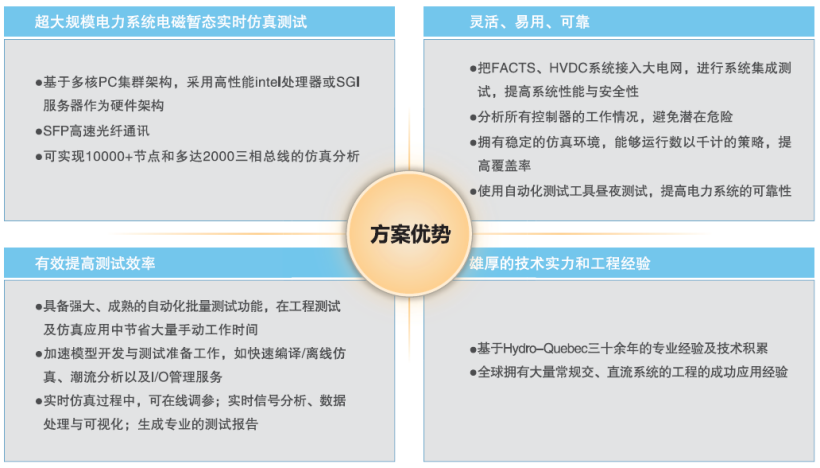
Electromagnetic Transient Real-Time Simulation & Testing for Ultra-Large-Scale Power Systems:

  • Based on a multi-core PC cluster architecture, high-performance Intel processors or SGl servers are employed as the hardware infrastructure.

  • SFP high-speed optical fiber communication

  • It can achieve simulation analysis for over 10,000 nodes and up to 2,000 three-phase buses.


Flexible, User-friendly and Reliable

  • Integrate FACTS and HVDC systems into the large power grid for system integration testing, improving system performance and safety

  • Analyze the working status of all controllers to avoid potential hazards

  • Possess a stable simulation environment capable of running thousands of strategies to improve coverage

  • Use automated testing tools to test day and night, enhancing the reliability of power systems


Effectively Improve Testing Efficiency

  • Possesses powerful and mature automated batch testing capabilities, saving substantial manual workload in engineering testing and simulation applications

  • Accelerates model development and testing preparation work, such as rapid compilation/offline simulation, power flow analysis, and real-time simulation of I/O management services, which allows online parameter tuning; real-time signal analysis, data processing and visualization; and generation of professional test reports


Solid Technical Expertise and Engineering Experience

  • Based on over thirty years of professional experience and technical accumulation from Hydro-Québec

  • Possesses extensive successful application experience in conventional AC/DC system projects worldwide


System Principle

HYPERSIM provides a comprehensive solution for AC/DC power grid simulation, encompassing various grid systems including FACTS, SVC, STATCOM, MMC, and HVDC; the HYPERSIM real-time simulator consists of a CPU simulator utilizing Intel Xeon processors and a Xilinx FPGA simulator, with the CPU simulator performing parallel processing simulation calculations for electromagnetic transient simulation of large-scale complex power systems, and the FPGA simulator handling high-frequency power electronics device simulations at the microsecond level while also serving as an interface unit connecting external devices to the CPU simulator.

image.png

Solutions

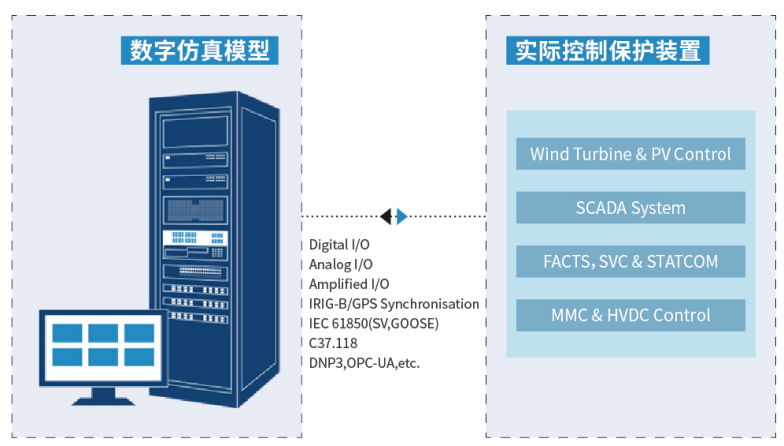
HIL Simulation of Control and Protection Devices

The fully digital simulation program HYPERSIM interacts with control and protection devices only through (control) signals, typically within a voltage range of -15V to +15V, where the interface functions as a signal interface; HYPERSIM outputs switch status signals, tap position information, etc., to DC control and protection devices via D/A or D/O interfaces, while the control and protection devices feed relevant control signals back to the simulation program through A/D and D/I interfaces, with all interactive signal transmissions implemented via dedicated cables or optical fibers.


Hybrid Simulation of Interconnected Digital Simulation and Physical Simulation Devices

The interconnection between HYPERSIM and a primary physical simulation device requires the completion of power transfer between the two. Since the power at the output port of the digital side is at the milliwatt level, while the power at the port of the physical simulation device is generally around tens of watts, an appropriate energy conversion device must be selected. By applying the transmission line decoupling method to the hybrid digital-analog simulation, transmission line components commonly used in power systems can be employed to achieve network segmentation between the digital and physical sides. The wave process of the distributed parameter line is converted into a lumped parameter circuit containing only resistors and current sources. The electromagnetic connection at both ends of the line is realized by equivalent current sources, dividing the power network into two independent networks for parallel computation.


Hybrid Simulation of Asynchronous Interconnection Between Different Simulation Software

Applying the transmission line decoupling method to hybrid simulations across different simulation software enables the use of transmission line components commonly employed in power systems to achieve co-simulation between software with varying simulation step sizes.


The interconnection between different simulation software facilitates integrated simulation of AC large-scale power grids with HVDC, UHVDC, VSC-HVDC, back-to-back DC systems, DC control and protection systems, system stability devices, and various relay protection devices. Simultaneously, it enables the interconnection of simulation systems with other simulation equipment, such as power electronic devices (e.g., TCSC, STATCOM), renewable energy sources (e.g., wind power, solar power), and energy storage devices. This framework not only supports real-time simulation studies of large-scale AC/DC transmission systems but also dynamically tracks grid data changes, seamlessly integrating with security control and online monitoring systems (e.g., WAMS, PMU) of the entire large-scale power grid. The implementation of this co-simulation system will further expand the research domains and application scope of digital simulation, including control systems and dynamic systems.


+86-21-54234720-8601