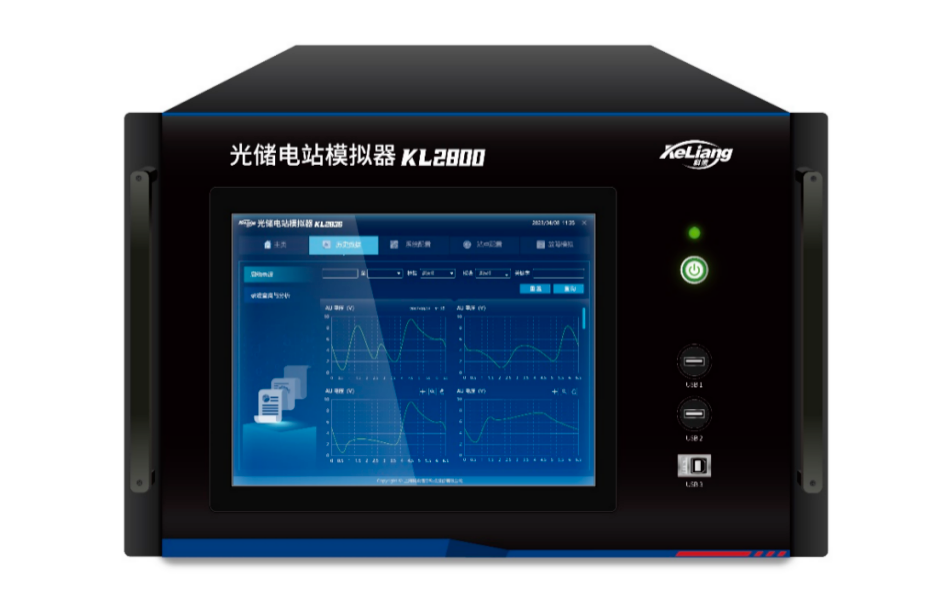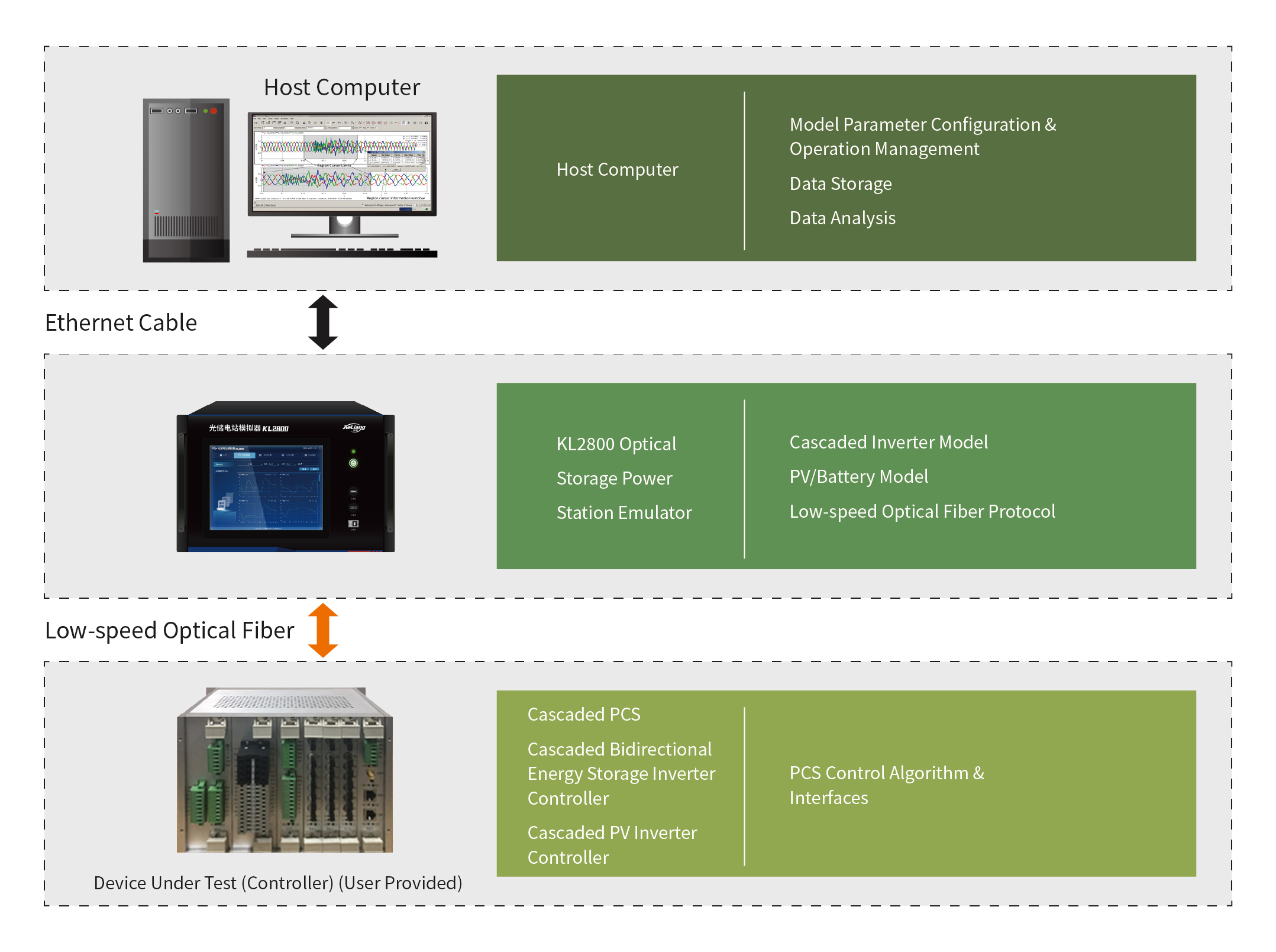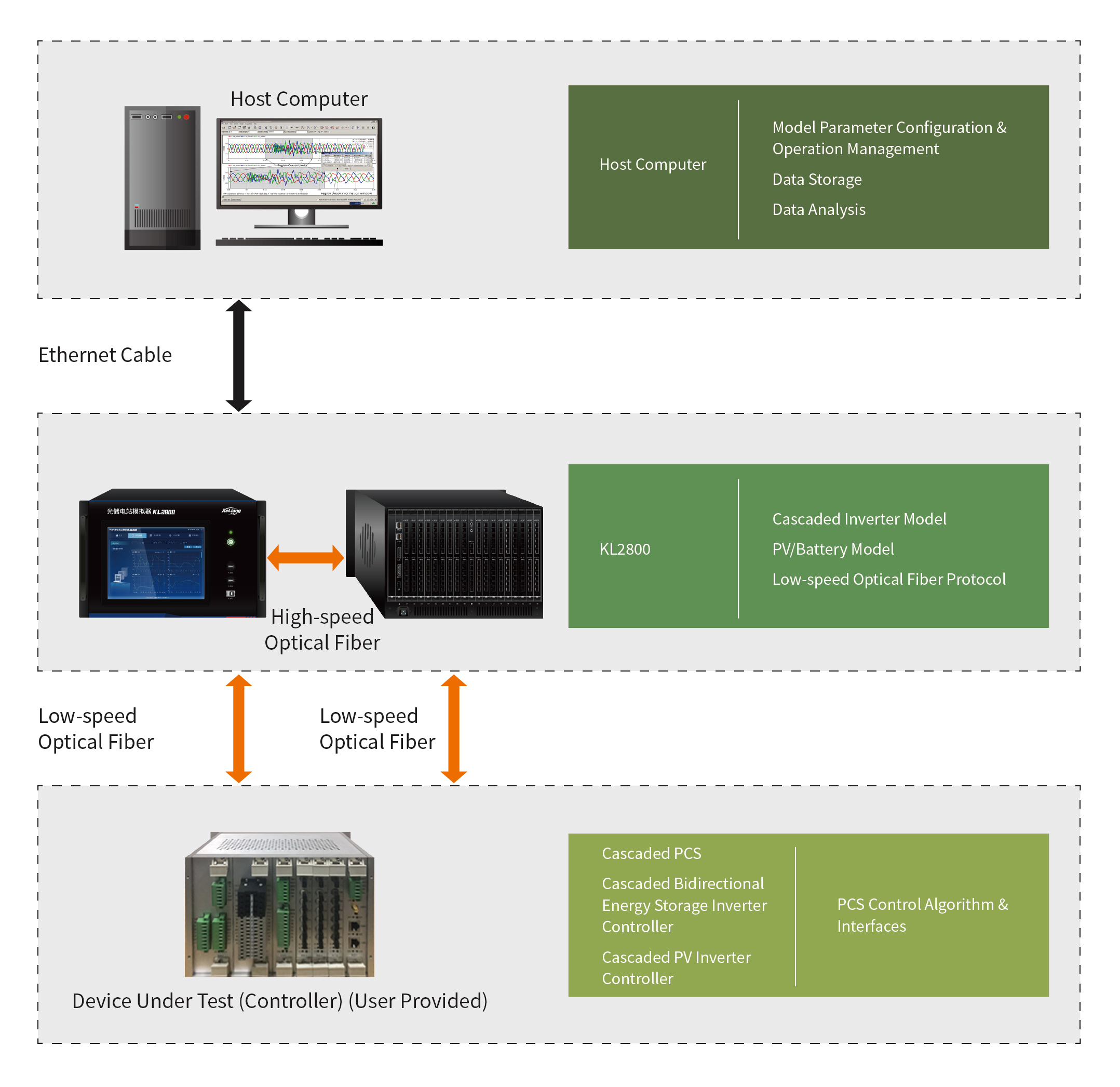
The system consists of three parts: a host computer, the KL2800 Optical Storage Power Station Emulator, and the user's device under test (controller). A single KL2800 Optical Storage Power Station Emulator has 216 low-speed and 8 high-speed optical fiber interfaces, enabling testing of up to 72 levels of inverter controllers (for 10kV, 35kV). Two KL2800 units can operate in parallel to achieve testing of up to 144 levels of inverter controllers (for 66kV).
The system architecture is shown in the figure below.
1.Testing Architecture of the KL2800 Optical Storage Power Station Emulator
2.Parallel Operation Testing Architecture of the KL2800 Optical Storage Power Station Emulator
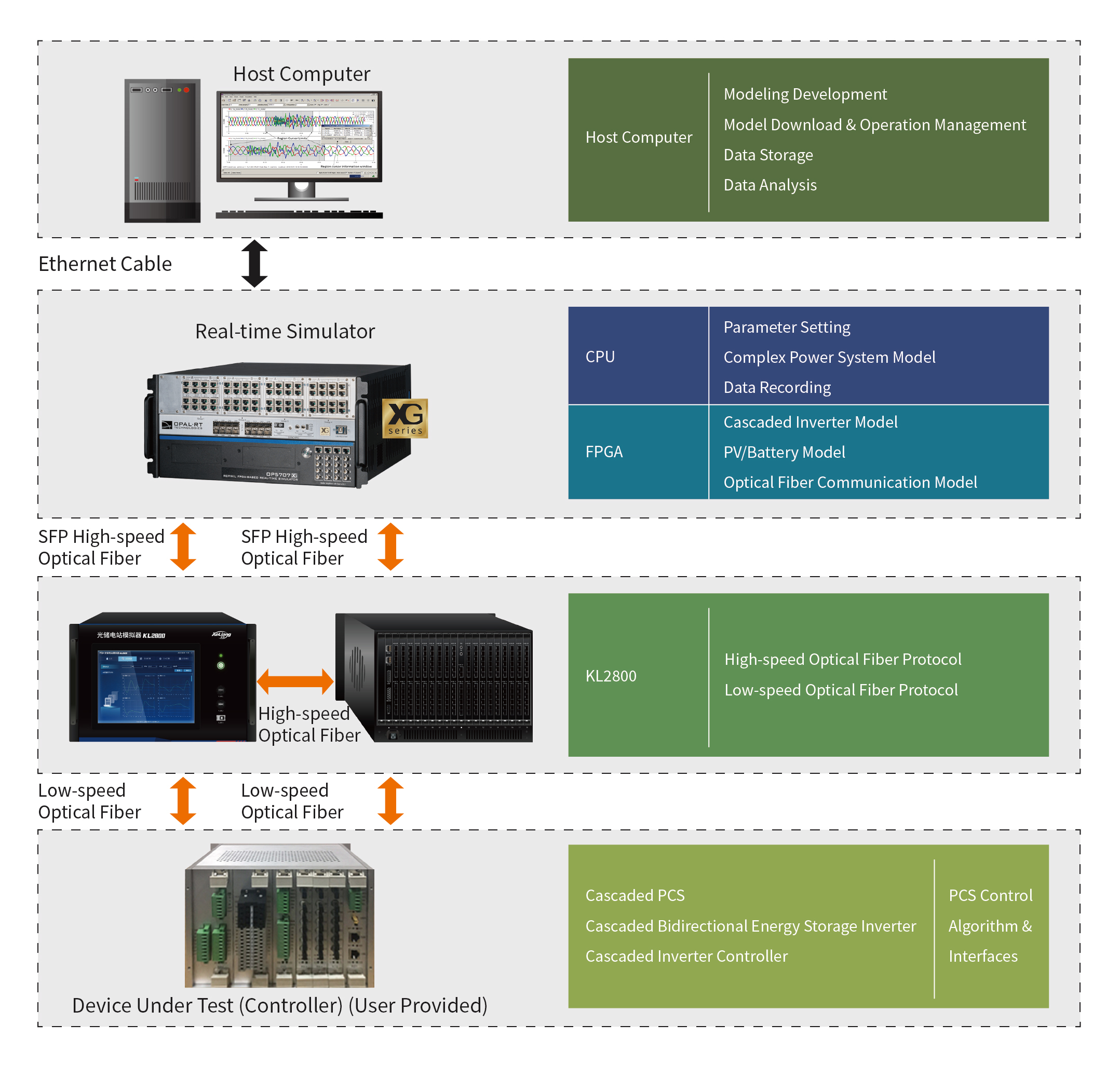
The KL2800 Optical Storage Power Station Emulator enables the conversion of low-speed optical fiber signals to high-speed optical fiber signals. The system, combined with a real-time simulator, facilitates testing of optical storage power station inverters.
The system consists of four parts: a host computer, a real-time simulator, the KL2800 Optical Storage Power Station Emulator, and the device under test (controller) (user provided). Models for the optical storage inverter and battery/PV panels run on the real-time simulator. A single KL2800 Optical Storage Power Station Emulator can achieve conversion from low-speed to high-speed optical fiber signals for up to 216 channels (maximum 72 levels, 10kV, 35kV) of optical storage inverter controller signals.
The system architecture is as follows:
Guided by China's action plans for achieving "carbon peak" by 2030 and "carbon neutrality" by 2060, the installed capacity and power generation share of wind and solar energy are increasingly rising, with their proportion in the energy structure continuously growing. However, new energy sources such as photovoltaic (PV) and wind power are characterized by volatility, intermittency, and randomness. Concurrently, against the backdrop of high-quality economic development, the proportion of electricity consumption by the tertiary industry and residential households is gradually increasing, leading to an expansion of the peak-to-valley difference rate in the load curve. Instabilities on both the generation side and the user side can significantly impact the stability of grid operation. To ensure a smooth transition of the energy structure, flexible resources such as energy storage are required for regulation. As a high-quality flexible resource, energy storage can play roles in peak shaving, frequency regulation, and backup on the power source side, grid side, and user side, and is gradually becoming an essential requirement for ensuring the development of the IBR-dominated power system.
Many regions have established energy storage development targets for the "14th Five-Year Plan" period, promoting energy storage development through multiple measures. The scale of energy storage construction is projected to reach 67 GW by 2025. Nearly 30 provinces in China have stipulated mandatory energy storage allocation requirements within guaranteed scales, with clear requirements for supporting energy storage construction for centralized PV, distributed PV, and wind power projects. Cascaded energy storage systems adopt a three-phase star-connected cascaded H-bridge topology, capable of directly outputting 0.4~35 kV three-phase AC voltage without a transformer for grid connection. A single system can achieve an output power exceeding 10 MW.
How to verify the grid-connection characteristics, power station-level safety, and grid-friendly interactive functions of new PV and energy storage technology routes—especially when using cascaded H-bridge multilevel converters as grid-tied converters for optical storage power stations—poses a challenge. Given the numerous interfaces and complex model structures involved, traditional hardware-in-the-loop (HIL) testing software and hardware can hardly meet the demands of practical testing applications.
In response to the testing needs arising from the rapid development of the cascaded PV and energy storage industry, KeLiang has proposed simulation testing solutions and test systems specifically for cascaded PV and energy storage power station systems. These solutions support design verification, R&D process verification, factory acceptance testing, and grid-connection certification for inverters and power station-level systems in the optical storage industry.
The hardware specifications of the KL2800 Optical Storage Power Station Emulator are as follows:
216 low-speed LC optical signal interfaces, with a maximum communication rate of 50 Mbps;
■ 8 high-speed LC optical fiber interfaces, with a maximum communication rate of 5 Gbps;
■ Equipped with 2 Ethernet interfaces;
■ 1 USB interface;
■ 2 RS232 interfaces;
■ 2 CAN interfaces;
■ Features a synchronization interface enabling parallel operation of two units;
■ 19-inch, 7U rack-mountable standard chassis, dimensions: Height 7U * Depth 360 mm * Width 482.6 mm.
The model/software specifications of the KL2800 Optical Storage Power Station Emulator are as follows:
■ Features model parameter configuration functionality;
■ Features data recording functionality;
■ Utilizes an FPGA-based approach to simulate cascaded PV/energy storage power stations;
■ Capable of solving models for 3-phase PV/energy storage power stations with 1 to 72 levels per phase;
■ Equipped with low-speed/high-speed optical fiber communication interfaces for hardware-in-the-loop testing with PV/energy storage inverter controllers;
■ Supports parallel connection of two units to achieve testing for up to 144 levels of PV/energy storage inverter controllers.

《GB/T 38755-2019 Guideline for Security and Stability of Power System》
《GB/T 19964-2012 Technical Requirements for Connecting Photovoltaic Power Station to Power System》
《GB/T 32826-2016 Guideline for Modeling of Photovoltaic Power Generation System》
《GB/T 32892-2016 Testing Procedure for Models and Parameters of Photovoltaic Power Generation System》
《Q/GDW 10993-2017 Modeling and Parameter Testing Procedure for Photovoltaic Power Station》
《GB/T 37409-2019 Technical Specification for Testing of Grid-connected Inverters for Photovoltaic Power Generation》
《GB/T 37408-2019 Technical Requirements for Grid-connected Inverters for Photovoltaic Power Generation》
《GB/T 34120-2017 Technical Specification for Energy Storage Converters of Electrochemical Energy Storage System》
《GB/T 36547-2018 Technical Requirements for Connecting Electrochemical Energy Storage System to Power Grid》
《GB/T 36548-2018 Testing Specification for Connecting Electrochemical Energy Storage System to Power Grid》